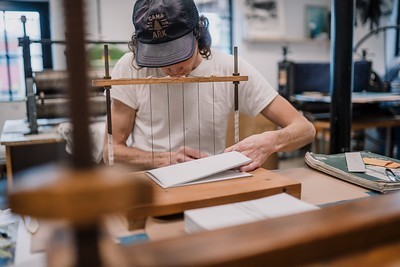
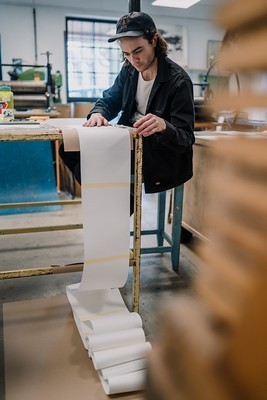
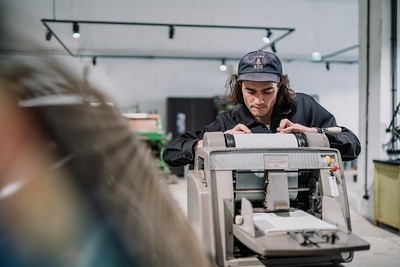
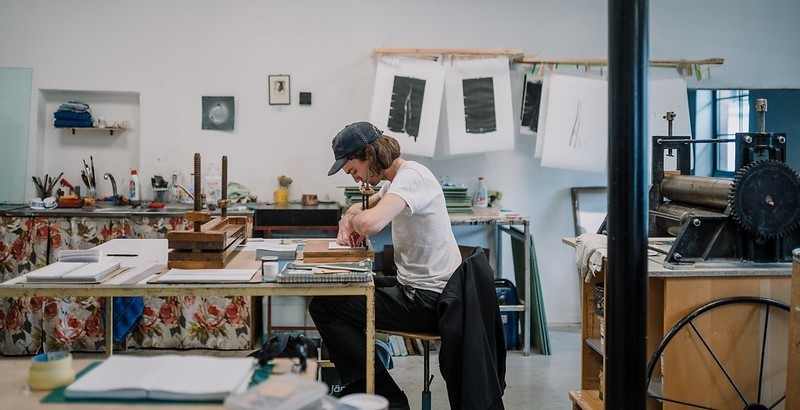
Joel Freeman is an art worker and artist living in Los Angeles, California. He engages technologies of reproduction as tools of art making, an interest which runs through his longstanding bookbinding practice. He spent the spring of 2022 in residence at TYPA.
I originally applied for a residency at TYPA because, in a listing, it was tagged with “bookbinding,” “printmaking,” and “photography,” all facility-specific mediums that I work in. Its website included intriguing descriptions of equipment within its collection that I’d never heard of. Nor did I know much about Estonia. Over the three months that I lived in Tartu, TYPA, through its setting and support, served as my entry point into the entwined histories of its collection and country.
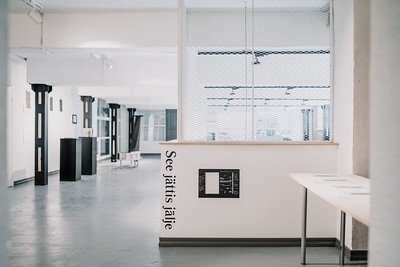
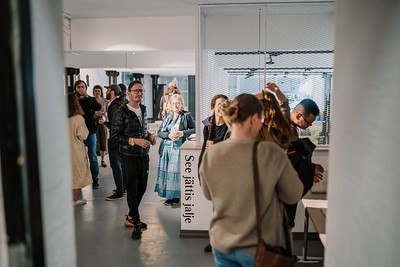
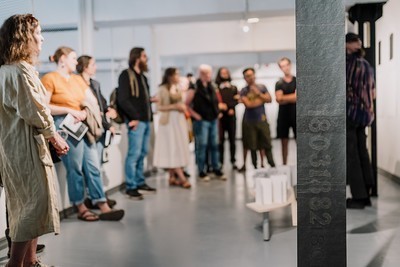
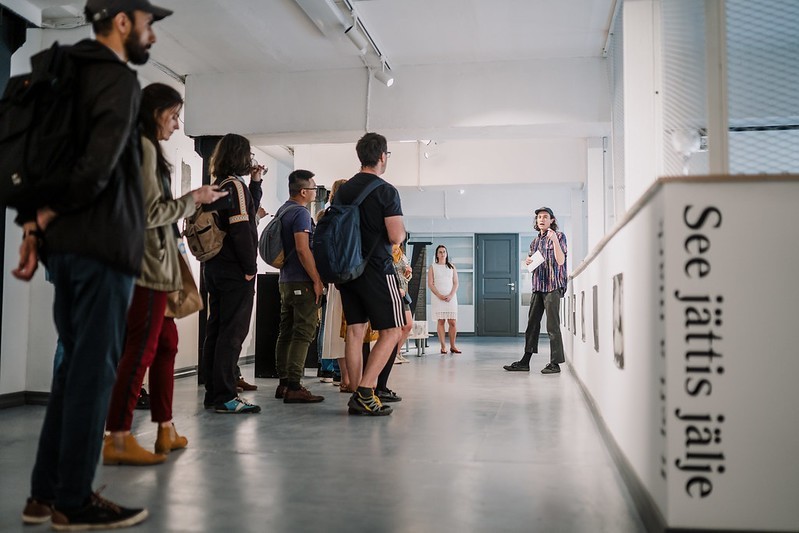
I found myself in Tartu in the cold of early spring with patches of snow tucked into shadows. Having arrived from Los Angeles, a city notorious for its tenuous relationship to memory, I was immediately struck by the way in which history so explicitly marks the landscape of Tartu. That first evening, as the sun set over the river Emajõgi, I wandered between memorial statues of Estonian poets and folklorists, and returned to my second-story flat where the 14th century St John’s church was my neighbor. The next day, I visited TYPA and was greeted warmly with conversation and fresh coffee before tagging along on an English language tour of the museum. Their collection spans 20th century printmaking technologies, most of it restored to operability. My mind buzzed with potential projects as Danila guided us through cases of wooden type and the machines developed to transfer their forms onto paper, a production bindery and pre-press camera so large that it spans two rooms. That night, awake with jet lag, I filled pages of my sketchbook with the seeds of ideas that would eventually grow into my final exhibition, “See jättis jälje / It left a mark.”
Though this title is an explicit reference to the processes I used to create my body of work — graphite rubbings, darkroom photography, various means of printmaking — the transference of some surface onto another — it is equally true of my experience in Tartu, that I am marked by it. So much of this is due to those I met at TYPA. Without a doubt, I would not have made and learned what I did if it were not for them, for their conversation and instruction, their ideas and suggestions. Whether it was the evolution of the Russian Cyrillic alphabet, the Estonian translation of Laurie Anderson song lyrics, the operation of the biggest camera I’d ever seen in my life, the significance of mimeographs in the production of state-banned texts, the help I received with graphic layouts or understanding the contemporary significance of Tartu’s various monuments — all of this arose from my being amongst TYPA’s community.
But of course, my residency was not all work. As the Estonian spring began stretching into summer, its days began holding space for more than I thought possible. I would spend what felt like a full day in the studio or darkroom and then, marvelously, get a second day with new friends in those incredible light nights. Music shows and saunas on the river, outdoor bars and movies and cemetery walks and as much karaoke as possible. My residency at TYPA left a mark, visible through its influence on my art practice, my understanding of a different point of reference, in the relationships that I carry with me.